
Instrumentation and musicianship
As the band and its sound matured over thirty years of touring, playing, and recording, each member's stylistic contribution became more defined, consistent, and identifiable. Jerry Garcia's lead lines were fluid, supple and spare, owing a great deal of their character to his experience playing Scruggs style banjo, an approach which often makes use of note syncopation, accenting, arpeggios, staccato chromatic runs, and the anticipation of the downbeat.
Garcia had a distinctive sense of timing, often weaving in and out of the groove established by the rest of the band as if he were pushing the beat. His lead lines were also immensely influenced by jazz soloists: Garcia cited Miles Davis, Ornette Coleman, Bill Evans, Pat Martino, George Benson, Al Di Meola, Art Tatum, Duke Ellington, and Django Reinhardt as primary influences, and frequently utilized techniques common to Country and Blues music in songs that called back to those traditions.
Jerry Garcia often switched scales in the midst of a solo depending upon the chord changes played underneath, though he nearly always finished phrases by landing on the chord-tones. Jerry most frequently played in the Mixolydian mode, though his solos and phrases often incorporated notes from the Dorian and major/minor pentatonic scales. Particularly in the late 1960s, Garcia occasionally incorporated melodic lines derived from Indian ragas into the band's extended, psychedelic improvisation, likely inspired by John Coltrane and other jazz artists' interest in the sitar music of Ravi Shankar.
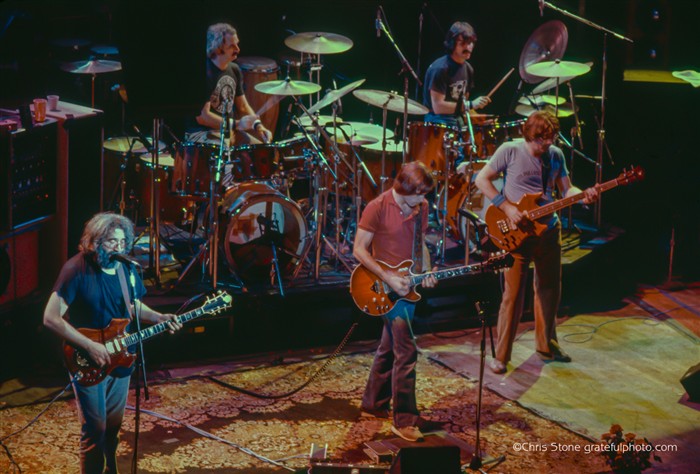
Phil Lesh was originally a classically trained trumpet player with an extensive background in music theory, but did not tend to play traditional blues-based bass forms. He often played more melodic, symphonic and complex lines, often sounding like a second lead guitar. In contrast to most bassists in popular music, Phil Lesh often avoids playing the root of a chord on the downbeat, instead withholding as a means to build tension. Lesh also rarely repeats the same bassline, even from performance to performance of the same song, and often plays off of or around the other instruments with a syncopated, staccato bounce that contributes to the Dead's unique rhythmic character.
Bob Weir, too, was not a traditional rhythm guitarist, but tended to play unique inversions at the upper end of the Dead's sound. Bob Weir modeled his style of playing after jazz pianist McCoy Tyner and attempted to replicate the interplay between John Coltrane and Tyner in his support, and occasional subversion, of the harmonic structure of Jerry Garcia's voice leadings. This would often influence the direction the band's improvisation would take on a given night. Bob Weir and Jerry Garcia's respective positions as rhythm and lead guitarist were not always strictly adhered to, as Weir would often incorporate short melodic phrases into his playing to support Garcia and occasionally took solos,
often played with a slide. Weir's playing is characterized by a "spiky, staccato" sound.
The band's two drummers, Mickey Hart and Bill Kreutzmann, developed a unique, complex interplay, balancing Kreutzmann's steady shuffle beat with Hart's interest in percussion styles outside the rock tradition. Kreutzmann has said, "I like to establish a feeling and then add radical or oblique juxtapositions to that feeling." Hart incorporated an 11-count measure to his drumming, bringing a dimension to the band's sound that became an important part of its style. He had studied tabla drumming and incorporated rhythms and instruments from World music, and later Electronic music, into the band's live performances.
The Dead's live performances featured multiple types of improvisation derived from a vast array of musical traditions. Not unlike many rock bands of their time, the majority of the Dead's songs feature a designated section in which an instrumental break occurs over the chord changes. These sections typically feature solos by Garcia that often originate as variations on the song's melody, but go on to create dynamic phrases that resolve by returning to the chord-tones. Not unlike traditional improvisational jazz, they may occasionally feature several solos by multiple instruments within an undecided number of bars, such as a keyboardist, before returning to the melody. At the same time, Dead shows almost always feature a more collective, modal approach to improvisation that typically occurs during segues between songs before the band modulates to a new tonal center. Some of the Dead's more extended jam vehicles, such as "The Other One", "Dark Star", and "Playing in the Band" almost exclusively make use of modulation between modes to accompany simple two-chord progressions.
Lyrical themes
Following the songwriting renaissance that defined the band's early 1970s period, as reflected in the albums Workingman's Dead and American Beauty, Robert Hunter, Jerry Garcia's primary lyrical partner, frequently made use of motifs common to American folklore including trains, guns, elements, traditional musical instruments, gambling, murder, animals, alcohol, descriptions of American geography, and religious symbolism to illustrate themes involving love and loss, life and death, beauty and horror, and chaos and order.
Following in the footsteps of several American musical traditions, these songs are often confessional and feature narration from the perspective of an antihero. Critic Robert Christgau described them as "American myths" that later gave way to "the old karma-go-round". An extremely common feature in both Robert Hunter's lyrics, as well as the band's visual iconography, is the presence of dualistic and opposing imagery illustrating the dynamic range of the human experience (Heaven and hell, law and crime, dark and light, etc.).
Hunter and Garcia's earlier, more directly psychedelic-influenced compositions often make use of surreal imagery, nonsense, and whimsey reflective of traditions in English poetry. In a retrospective, The New Yorker described Hunter's verses as "elliptical, by turns vivid and gnomic", which were often "hippie poetry about roses and bells and dew". Grateful Dead biographer Dennis McNally has described Hunter's lyrics as creating "a non-literal hyper-Americana" weaving a psychedelic, kaleidoscopic tapestry in the hopes of elucidating America's national character. At least one of Hunter and Bob Weir's collaborations, "Jack Straw", was inspired by the work of John Steinbeck.
Influence and legacy
Grateful Dead have been called a "symbol of the counterculture movement of the sixties". Beginning in the early 1990s, a new generation of bands became inspired by the Grateful Dead's improvisational ethos and marketing strategy, and began to incorporate elements of the Grateful Dead's live performances into their own shows.
These include the nightly alteration of setlists, frequent improvisation, the blending of genres, and the allowance of taping, which would often contribute to the development of a dedicated fanbase. Bands associated with the expansion of the "jam scene" include Phish, The String Cheese Incident, Widespread Panic, Blues Traveler, Moe, and the Disco Biscuits.
Many of these groups began to look past the American roots music that the Grateful Dead drew inspiration from, and incorporated elements of Progressive rock, Hard rock, and Electronica. At the same time, the Internet gained popularity and provided a medium for fans to discuss these bands and their performances and download MP3s. The Grateful Dead, as well as Phish, were one of the first bands to have a Usenet newsgroup.
Merchandising and representation
Hal Kant was an entertainment industry attorney who specialized in representing musical groups. He spent 35 years as principal lawyer and general counsel for the Grateful Dead, a position in the group that was so strong that his business cards with the band identified his role as "Czar".
Kant brought the band millions of dollars in revenue through his management of the band's intellectual property and merchandising rights. At Kant's recommendation, the group was one of the few rock 'n roll pioneers to retain ownership of their music masters and publishing rights.
In 2006, the Grateful Dead signed a ten-year licensing agreement with Rhino Entertainment to manage the band's business interests including the release of musical recordings, merchandising, and marketing. The band retained creative control and kept ownership of its music catalog.
A Grateful Dead video game titled Grateful Dead Game – The Epic Tour was released in April 2012 and was created by Curious Sense.
In November 2022, the children's book The ABCs of The Grateful Dead was released. Authorized by the group, it was written by Howie Abrams, illustrated by Michael "Kaves" McLeer, and published by Simon & Schuster.
Sponsorship of 1992 Lithuanian Olympic basketball team
After Lithuania gained its independence from the USSR, the country announced its withdrawal from the 1992 Olympics due to the lack of any money to sponsor participants. But NBA star Šarūnas Marčiulionis, a native Lithuanian basketball star, wanted to help his native team to compete. His efforts resulted in a call from representatives of the Grateful Dead who set up a meeting with the band members. The band agreed to fund transportation costs for the team (about $5,000) along with Grateful Dead designs for the team's jerseys and shorts. The Lithuanian basketball team won the bronze medal and the Lithuanian basketball/Grateful Dead T-shirts became part of pop culture, especially in Lithuania. The incident was covered by the documentary The Other Dream Team.
Live performances
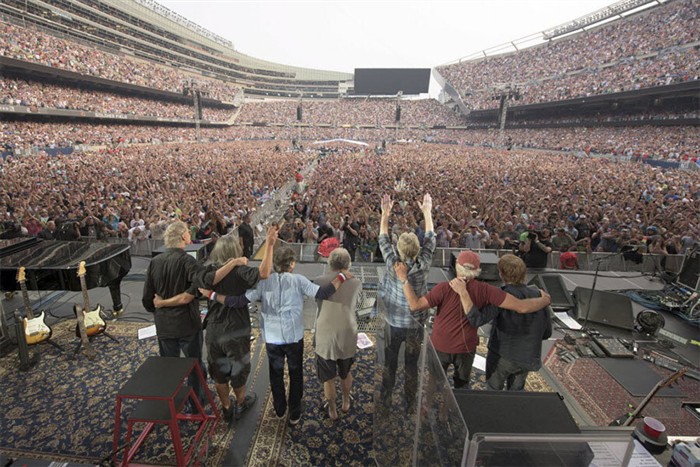
The Grateful Dead toured constantly throughout their career, playing more than 2,300 concerts. They promoted a sense of community among their fans, who became known as "Deadheads", many of whom followed their tours for months or years on end. Around concert venues, an impromptu communal marketplace known as "Shakedown Street" was created by Deadheads to serve as centers of activity where fans could buy and sell anything from grilled cheese sandwiches to homemade T-shirts and recordings of Grateful Dead concerts.
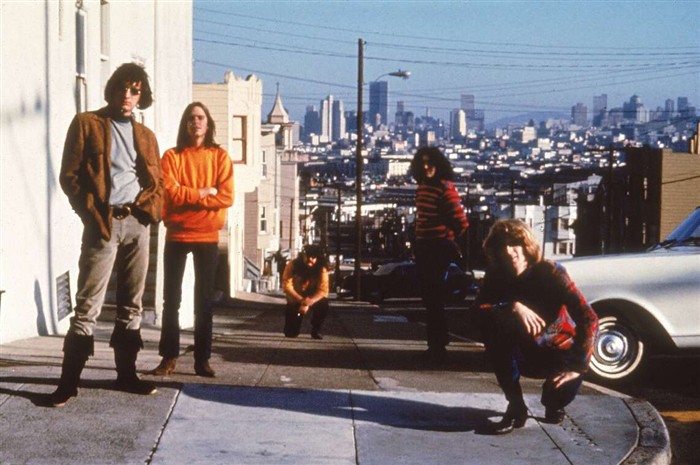
In their early career, the band also dedicated their time and talents to their community, the Haight-Ashbury area of San Francisco, making available free food, lodging, music, and health care to all. It has been said that the band performed "more free concerts than any band in the history of music". With the exception of 1975, when the band was on hiatus and played only four concerts, Grateful Dead performed many concerts every year, from their formation in April 1965, until July 9, 1995. Initially all their shows were in California, principally in the San Francisco Bay Area and in or near Los Angeles. They also performed, in 1965 and 1966, with Ken Kesey and the Merry Pranksters, as the house band for the Acid Tests.
In 1967, they toured nationally, including their first performance in New York City. They appeared at the Monterey Pop Festival in 1967, the Woodstock Festival in 1969 and the Festival Express train tour across Canada in 1970. They were scheduled to appear as the final act at the infamous Altamont Free Concert on December 6, 1969, after the Rolling Stones but withdrew after security concerns. "That's the way things went at Altamont—so badly that the Grateful Dead, prime organizers and movers of the festival, didn't even get to play", staff at Rolling Stone magazine wrote in a detailed narrative on the event.
Their first UK performance was at the Hollywood Music Festival in 1970. Their largest concert audience came in 1973 when they played, along with The Allman Brothers Band and The Band, before an estimated 600,000 people at the Summer Jam at Watkins Glen. They played to an estimated total of 25 million people, more than any other band, with audiences of up to 80,000 attending a single show. Many of these concerts were preserved in the band's tape vault, and several dozen have since been released on CD and as downloads. The Dead were known for the tremendous variation in their setlists from night to night—the list of songs documented to have been played by the band exceeds 500. The band has released four concert videos under the name View from the Vault. In 1978, they played three nights at the Great Pyramid of Giza in Egypt.
In the 1990s, the Grateful Dead earned a total of $285 million in revenue from their concert tours, the second-highest during the 1990s, with the Rolling Stones earning the most. This figure is representative of tour revenue through 1995, as touring stopped after the death of Jerry Garcia.
In a 1991 PBS documentary, segment host Buck Henry attended an August 1991 concert at Shoreline Amphitheatre and gleaned some information from some band members about the Grateful Dead phenomenon and its success. At the time, Jerry Garcia stated, "We didn't really invent the Grateful Dead, the crowd invented the Grateful Dead, you know what I mean? We were sort of standing in line, and uh, it's gone way past our expectations, way past, so it's, we've been going along with it to see what it's gonna do next."
Mickey Hart said, "This is one of the last places in America that you can really have this kind of fun, you know, considering the political climate and so forth." Hart also stated that "the transformative power of the Grateful Dead is really the essence of it; it's what it can do to your consciousness. We're more into transportation than we are into music, per se, I mean, the business of the Grateful Dead is transportation."
One of the band's largest concerts took place just months before Garcia's death, at their outdoor show with Bob Dylan in Highgate, Vermont, on June 15, 1995. The crowd was estimated to be over 90,000; overnight camping was allowed and about a third of the audience got in without having purchased a ticket.
Their numerous studio albums were generally collections of new songs that they had first played in concert. The band was also famous for its extended musical improvisations, having been described as having never played the same song the same way twice. Their concert sets often blended songs, one into the next, often for more than three songs at a time.
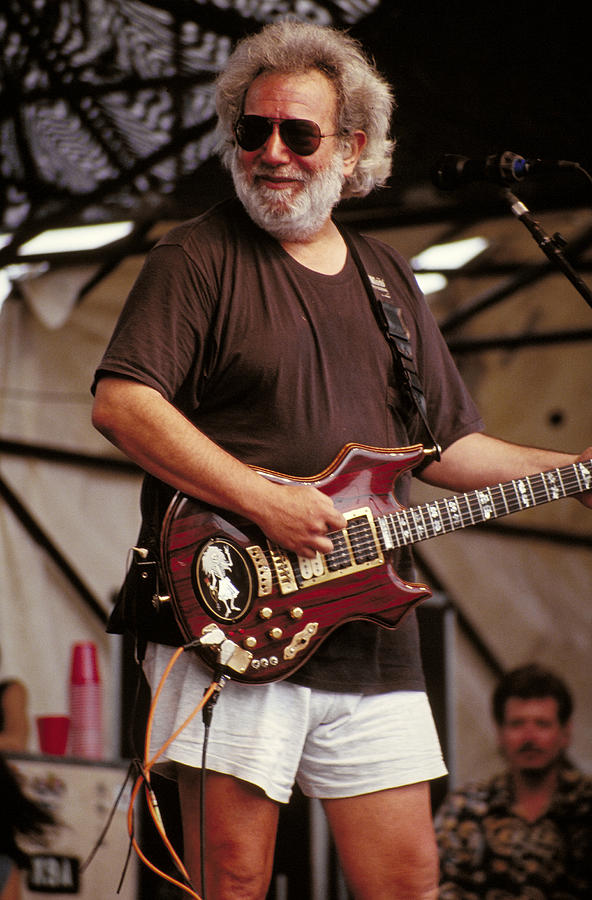
Concert sound systems
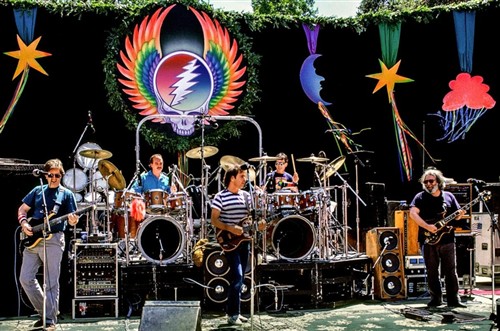
The Wall of Sound was a large sound system designed specifically for the band. The band was never satisfied with the house system anywhere they played. After the Monterey Pop Festival, the band's crew 'borrowed' some of the other performers' sound equipment and used it to host some free shows in San Francisco. In their early days, soundman Owsley "Bear" Stanley designed a public address (PA) and monitor system for them. Stanley was the Grateful Dead's soundman for many years; he was also one of the largest suppliers of LSD.
Stanley's sound systems were delicate and finicky, and frequently brought shows to a halt with technical breakdowns. After Stanley went to jail for manufacturing LSD in 1970, the group briefly used house PA's, but found them to be even less reliable than those built by their former soundman. On February 2, 1970, the group contacted Bob Heil to use his system. In 1971, the band purchased their first solid-state sound system from Alembic Studios. Because of this, Alembic would play an integral role in the research, development, and production of the Wall of Sound. The band also welcomed Dan Healy into the fold on a permanent basis that year. Healy would mix the Grateful Dead's live sound until 1993.
Following Jerry Garcia's death and the band's breakup in 1995, their current sound system was inherited by Dave Matthews Band. Dave Matthews Band debuted the sound system April 30, 1996, at the first show of their 1996 tour in Richmond, Virginia.
Tapes
Like several other bands at the time, the Grateful Dead allowed their fans to record their shows. For many years the tapers set up their microphones wherever they could, and the eventual forest of microphones became a problem for the sound crew. Eventually, this was solved by having a dedicated taping section located behind the soundboard, which required a special "tapers" ticket. The band allowed sharing of their shows, as long as no profits were made on the sale of the tapes.
Of the approximately 2,350 shows the Grateful Dead played, almost 2,200 were taped, and most of these are available online. The band began collecting and cataloging tapes early on and Dick Latvala was their keeper. "Dick's Picks" is named after Latvala. After his death in 1999, David Lemieux gradually took the post. Concert set lists from a subset of 1,590 Grateful Dead shows were used to perform a comparative analysis between how songs were played in concert and how they are listened online by Last.fm members.
In their book Marketing Lessons from the Grateful Dead: What Every Business Can Learn From the Most Iconic Band in History, David Meerman Scott and Brian Halligan identify the taper section as a crucial contributor to increasing the Grateful Dead's fan base.
Iconography
Over the years, a number of iconic images have come to be associated with the Grateful Dead. Many of these images originated as artwork for concert posters or album covers.
Skull and Roses
The skull and roses design was composed by Alton Kelley and Stanley Mouse, who added lettering and color, respectively, to a black and white drawing by Edmund Joseph Sullivan. Sullivan's drawing was an illustration for a 1913 edition of the Rubaiyat of Omar Khayyam. Earlier antecedents include the custom of exhibiting the relic skulls of Christian martyrs decorated with roses on their feast days.
The rose is an attribute of Saint Valentine, who according to one legend, was martyred by decapitation. Accordingly, in Rome, at the church dedicated to him, the observance of his feast day included the display of his skull surrounded by roses. Kelley and Mouse's design originally appeared on a poster for the September 16 and 17, 1966, Dead shows at the Avalon Ballroom. Later, it was used as the cover for the album Grateful Dead (1971).
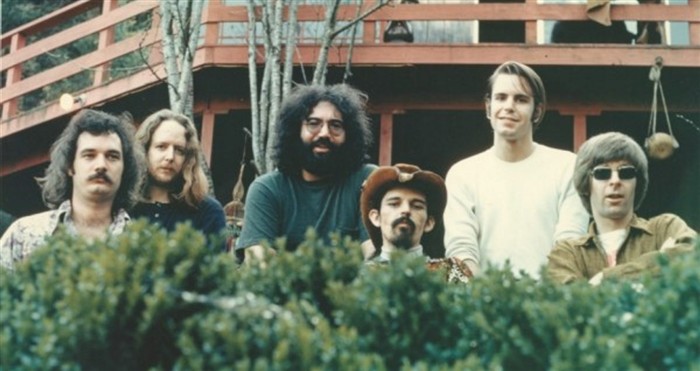
The album is sometimes referred to as Skull and Roses.
Jester
Another icon of the Dead is a skeleton dressed as a jester and holding a lute. This image was an airbrush painting, created by Stanley Mouse in 1972. It was originally used for the cover of The Grateful Dead Songbook.
"Dancing" Bears
A series of stylized bears who appear to be dancing was drawn by Bob Thomas as part of the back cover for the album History of the Grateful Dead, Volume One (Bear's Choice) (1973). Thomas reported that he based the bears on a lead sort from an unknown font. The bear is a reference to Owsley "Bear" Stanley, who recorded and produced the album. Bear himself wrote, "the bears on the album cover are not really 'dancing'. I don't know why people think they are; their positions are quite obviously those of a high-stepping march."
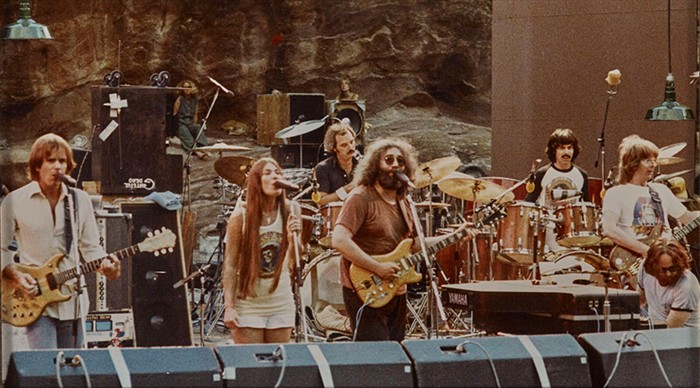
Steal Your Face Skull
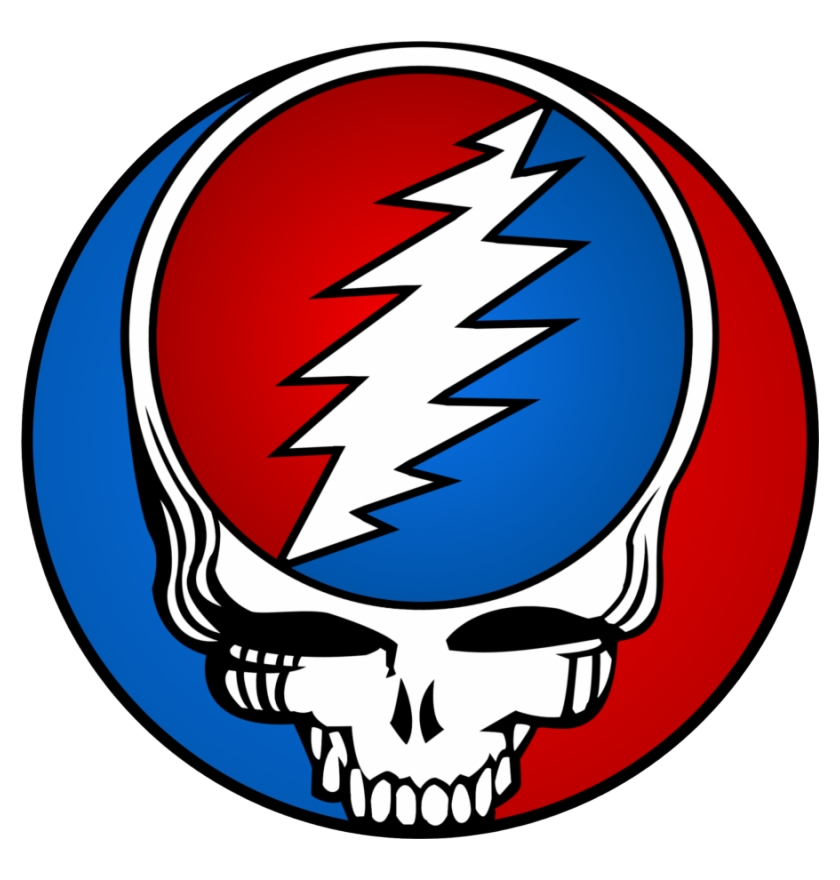
Perhaps the best-known Grateful Dead art icon is a red, white, and blue skull with a lightning bolt through it. The lightning bolt skull can be found on the cover of the album Steal Your Face (1976), and the image is sometimes known by that name. It was designed by Owsley Stanley and artist Bob Thomas, and was originally used as a logo to mark the band's equipment.
Dancing Terrapins
The two dancing terrapins first appeared on the cover of the album Terrapin Station (1977). They were drawn by Kelley and Mouse, based on a drawing by Heinrich Kley. Since then these turtles have become one of the Grateful Dead's most recognizable logos.
Uncle Sam Skeleton
The Uncle Sam skeleton was devised by Gary Gutierrez as part of the animation for The Grateful Dead Movie (1977). The image combines the Grateful Dead skeleton motif with the character of Uncle Sam, a reference to the then-recently written song "U.S. Blues", which plays during the animation.
Deadheads
Fans and enthusiasts of the band are commonly referred to as Deadheads. While the origin of the term may be unclear, Dead Heads were made canon by the notice placed inside the Skull and Roses (1971) album by manager Jon McIntire:
DEAD FREAKS UNITE: Who are you? Where are you? How are you?
Send us your name and address and we'll keep you informed.
Dead Heads, P.O. Box 1065, San Rafael, California 94901.
As each show featured a new setlist and a great deal of improvisation, Deadheads would often follow the band from city to city, attending many shows on a given tour. Many Deadheads speak of being drawn to the culture due to the sense of community that the band's shows tended to foster. Though Deadheads came from a wide array of demographics, many attempted to reproduce the aesthetics and values of the 1960s counterculture and were often stigmatized in the media. Because of the stereotyping of Deadheads as hippies, the band's shows became a common target for officials in the DEA and arrests at shows became common.
As a group, the Deadheads were considered very mellow. "I'd rather work nine Grateful Dead concerts than one Oregon football game", Police Det. Rick Raynor said. "They don't get belligerent like they do at the games." Despite this reputation, in the mid-1990s, as the band's popularity grew, there were a series of minor scuffles occurring at shows that peaked with a large scale riot at the Deer Creek Music Center near Indianapolis in July 1995.
This gate crashing incident caused the band to cancel the following night's show. Deadheads who appeared on the scene after the band's 1987 hit single "Touch of Grey", were often disparagingly referred to by older fans as "Touchheads". Beginning in the 1980s, a number of definable sects of Deadheads began to appear on the scene. These included the Wharf Rats, as well as the "spinners", named for their whirling-style of dancing and their use of the band's music to facilitate mystical experiences.
Deadheads, particularly those who collected tapes, were known for keeping close records of the band's setlists and for comparing various live versions of the band's songs, as reflected in publications such as the various editions of "Deadbase",
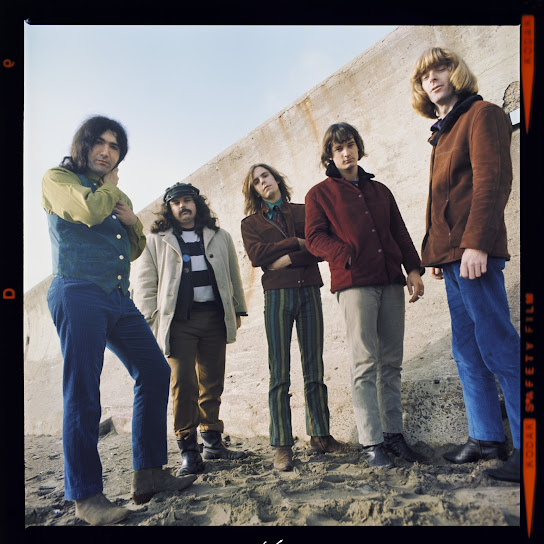
and "The Deadhead's Taping Compendium". This practice continues into the 21st century on digital forums and websites such as the Internet Archive, which features live recordings of nearly every available Grateful Dead show and allows users to discuss and review the site's shows.
The band has a number of influential and celebrity fans, including politicians, businesspeople, journalists, and other musicians.
Donation of archives to UC Santa Cruz
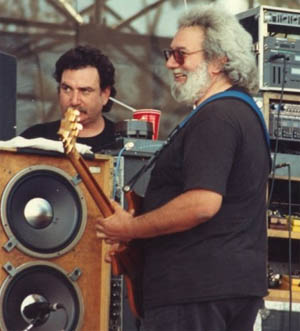
On April 24, 2008, members Bob Weir and Mickey Hart, along with Nion McEvoy, CEO of Chronicle Books, UC Santa Cruz chancellor George R. Blumenthal, and UC Santa Cruz librarian Virginia Steel, held a press conference announcing UCSC's McHenry Library would be the permanent home of the Grateful Dead Archive, which includes a complete archival history from 1965 to the present. The archive includes correspondence, photographs, fliers, posters, and several other forms of memorabilia and records of the band. Also included are unreleased videos of interviews and TV appearances that will be installed for visitors to view, as well as stage backdrops and other props from the band's concerts.
Blumenthal stated at the event, "The Grateful Dead Archive represents one of the most significant popular cultural collections of the 20th century; UC Santa Cruz is honored to receive this invaluable gift. The Grateful Dead and UC Santa Cruz are both highly innovative institutions—born the same year—that continue to make a major, positive impact on the world." Guitarist Bob Weir stated "We looked around, and UC Santa Cruz seems the best possible home. If you ever wrote the Grateful Dead a letter, you'll probably find it there!"
Professor of music Fredric Lieberman was the key contact between the band and the university, who let the university know about the search for a home for the archive, and who had collaborated with Mickey Hart on three books in the past, Planet Drum (1990), Drumming at the Edge of Magic (1991), and Spirit into Sound (2006).
The first large-scale exhibition of materials from the Grateful Dead Archive was mounted at the New-York Historical Society in 2010.
Awards
In 2004, Rolling Stone ranked the Grateful Dead No. 57 on their list of the 100 Greatest Artists of All Time.
On February 10, 2007, the Grateful Dead received a Grammy Lifetime Achievement Award. The award was accepted on behalf of the band by Mickey Hart and Bill Kreutzmann.
In 2011, a recording of the Grateful Dead's May 8, 1977, concert at Cornell University's Barton Hall was selected for induction into the National Recording Registry of the Library of Congress.
Twelve members of the Grateful Dead (the eleven official performing members plus Robert Hunter) were inducted into the Rock and Roll Hall of Fame in 1994, and Bruce Hornsby was their presenter.
In 2024 the band was named as one of the recipients of the Kennedy Center Honors. The three living core members (Weir, Hart and Kreutzmann) received the award. As he was named a recipient prior to his death, Lesh received the award posthumously.
On December 4, 2025, the Grateful Dead was awarded a Guinness World Records title for the most Top 40 albums in Billboard 200 history with 66 Top 40 albums. The Grateful Dead previously broke the record in February 2024 with 60 Top 40 albums after having been tied with Frank Sinatra and Elvis Presley for most Top 40 albums (59) in November 2023.
Closure
Lead guitarist Jerry Garcia was often viewed both by the public and the media as the leader or primary spokesperson for the Grateful Dead, but was reluctant to be perceived that way, especially since he and the other group members saw themselves as equal participants and contributors to their collective musical and creative output. Garcia, a native of San Francisco, grew up in the Excelsior District. One of his main influences was Bluegrass music, and he also performed—on banjo, one of his other great instrumental loves, along with the pedal steel guitar—in bluegrass bands, notably Old & In the Way with mandolinist David Grisman.
Ned Lagin, a young MIT student and friend of the band, guested with them many times from 1970 through 1975, providing a second keyboard as well as synthesizers. Upon graduating from MIT, he began touring with the band fulltime in 1974, performing sets of electronic music with Phil Lesh, occasionally with Jerry Garcia and Bill Kreutzmann, during the band's intermission. The "Ned and Phil" set became a regular fixture of that era, and was featured nearly every night during their Summer '74 and Europe '74 tours, as well as their five-night residency at the Winterland Ballroom during October 1974. Lagin is also featured in The Grateful Dead Movie. During 1974 and 1975, he would also occasionally play entire sets with the band, usually on Garcia's side of the stage, before ending his touring relationship with the band and focusing on his solo music projects, such as his album Seastones, which features several members of the Dead.
Bruce Hornsby never officially joined the band full-time because of his other commitments, but he did play keyboards at most Dead shows between September 1990 and March 1992, and sat in with the band over 100 times in all between 1988 and 1995. He added several Dead songs to his own live shows and Jerry Garcia referred to him as a "floating member" who could come and go as he pleased.
Robert Hunter and John Perry Barlow were the band's primary lyricists, starting in 1967 and 1971, respectively, and continuing until the band's dissolution. Hunter collaborated mostly with Jerry Garcia and John Perry Barlow mostly with Bob Weir, though each wrote with other band members as well. Both are listed as official members at Dead.net, the band's website, alongside the performing members. Barlow was the only member not inducted into the Rock and Roll Hall of Fame.
Albums
The Grateful Dead (1967)
Anthem of the Sun (1968)
Aoxomoxoa (1969)
Live/Dead (1969)
Workingman's Dead (1970)
American Beauty (1970)
Grateful Dead (Skull & Roses) (1971) live
Europe '72 (1972) live
History of the Grateful Dead, Volume One (Bear's Choice) (1973) live
Wake of the Flood (1973)
From the Mars Hotel (1974)
Blues for Allah (1975)
Steal Your Face (1976) live
Terrapin Station (1977)
Shakedown Street (1978)
Go to Heaven (1980)
Reckoning (1981) live
Dead Set (1981) live
In the Dark (1987)
Dylan & the Dead (1989) live
Built to Last (1989)
Without a Net (1990) live
Members
Jerry Garcia – lead and backing vocals, guitars (1965–1995; † 1995)
Bob Weir – lead and backing vocals, guitars (1965–1995; † 2026)
Phil Lesh – bass guitar, backing and lead vocals (1965–1995; † 2024)
Bill Kreutzmann – drums, percussion (1965–1995)
Ron "Pigpen" McKernan – lead and backing vocals, keyboards, organ, harmonica, percussion, occasional guitar (1965–1973; † 1973; not touring after June 17, 1972)
Mickey Hart – drums, percussion (1967–1971; 1974–1995)
Tom Constanten – keyboards (1968–1970)
Keith Godchaux – keyboards, backing vocals (1971–1979; † 1980)
Donna Jean Godchaux – backing and lead vocals (1971–1979; † 2025)
Brent Mydland – keyboards, backing and lead vocals (1979–1990; † 1990)
Vince Welnick – keyboards, backing and lead vocals (1990–1995; † 2006)
Robert Hunter – lyrics (1967–1995; † 2019)
John Perry Barlow – lyrics (1971–1995; † 2018)
Frequent collaborators
Ned Lagin – keyboards, synthesizers (1970–1975)
Bruce Hornsby – keyboards, vocals (1990–1992)
Source: Wikipedia